Freecell solitaire card game - classical
插件截图
插件概述
Freecell solitaire card game - classical插件详情
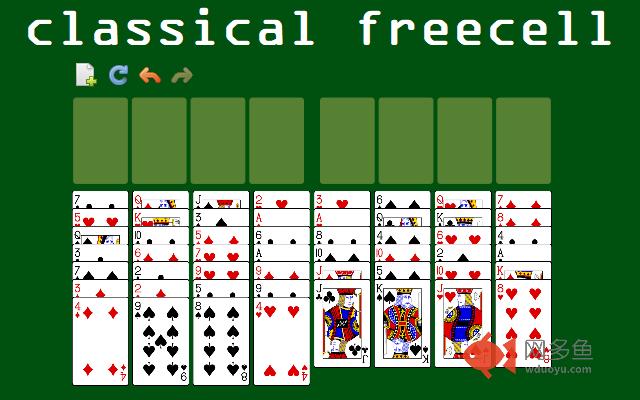
Freecell Solitaire in a click of a button, play directly in Chrome.FreeCell is a solitaire card game played using the standard 52-card deck. It is fundamentally different from most solitaire games in that very few deals are unsolvable, and all cards are dealt face-up from the very beginning of the game. Although software implementations vary, most versions label the hands with a number (derived from the seed value used by the random number generator to shuffle the cards).
** Rules **
>> Construction and layout
One standard 52-card deck is used.
There are four open cells and four open foundations. Some alternate rules use between one and ten cells.
Cards are dealt face-up into eight cascades, four of which comprise seven cards and four of which comprise six. Some alternate rules will use between four and ten cascades.
>> Building during play
The top card of each cascade begins a tableau.
Tableaux must be built down by alternating colors.
Foundations are built up by suit.
>> Moves
Any cell card or top card of any cascade may be moved to build on a tableau, or moved to an empty cell, an empty cascade, or its foundation.
Complete or partial tableaus may be moved to build on existing tableaus, or moved to empty cascades, by recursively placing and removing cards through intermediate locations. Computer implementations often show this motion, but players using physical decks typically move the tableau at once.
>> Victory
The game is won after all cards are moved to their foundation piles.
Not all deals are solvable, but the probability of an unsolvable deal is very low. It is estimated that 99.999% of possible deals are solvable
** History **
One of the oldest ancestors of FreeCell is Eight Off. In the June 1968 edition of Scientific American, Martin Gardner described in his "Mathematical Games" column a game by C. L. Baker that is similar to FreeCell, except that cards on the tableau are built by suit rather than by alternate colors. Gardner wrote, "The game was taught to Baker by his father, who in turn learned it from an Englishman during the 1920s."[This variant is now called Baker's Game. FreeCell's origins may date back even further to 1945 and a Scandinavian game called Napoleon in St. Helena (not the game Napoleon at St. Helena, also known as Forty Thieves).
Paul Alfille changed Baker's Game by making cards build according to alternate colors, thus creating FreeCell. He implemented the first computerised version of it in the TUTOR programming language for the PLATO educational computer system in 1978. Alfille was able to display easily recognizable graphical images of playing cards on the 512 × 512 monochrome display on the PLATO systems.
This original FreeCell environment allowed games with 4–10 columns and 1–10 cells in addition to the standard 8 × 4 game. For each variant, the program stored a ranked list of the players with the longest winning streaks. There was also a tournament system that allowed people to compete to win difficult hand-picked deals. Paul Alfille described this early FreeCell environment in more detail in an interview from 2000.
In 2012, researchers used evolutionary computation methods to create winning FreeCell players.
** Solver complexity **
The FreeCell game has a constant number of cards. This implies that in constant time, a person or computer could list all of the possible moves from a given start configuration and discover a winning set of moves or, assuming the game cannot be solved, the lack thereof. To perform an interesting complexity analysis one must construct a generalized version of the FreeCell game with 4 × n cards. This generalized version of the game is NP-complete; it is unlikely that any algorithm more efficient than a brute-force search exists that can find solutions for arbitrary generalized FreeCell configurations.
There are 52! (i.e., 52 factorial), or approximately 8×1067, distinct deals. However, some games are effectively identical to others because suits assigned to cards are arbitrary or columns can be swapped. After taking these factors into account, there are approximately 1.75×1064 distinct games.
We hope you enjoy the game :-)
其他信息
官方唯一标识:nkdapojj****************kpkkkage
官方最后更新日期:2018年9月24日
分类:娱乐
大小:16.86KiB
版本:1.4
语言:English
提供方:none
星级:4.6
插件下载
| 下载链接一 下载链接二 |
| Chrome插件离线安装教程 |
温馨提示
本站中的部份内容来源网络和网友发布,纯属个人收集并供大家交流学习参考之用,版权归版权原作者所有。
如果您发现网站上有侵犯您的知识产权的作品,请与我们取得联系,我们会及时修改或删除。
如果您觉得网多鱼对您有帮助,欢迎收藏我们 Ctrl+D。